June 15, 2026
Global oil markets are experiencing a fundamental shift as strategic resource accumulation patterns reshape decades-old supply and demand equilibriums. The traditional model of petroleum trade, where importing nations purchased crude oil primarily for immediate refining needs, has evolved into a complex system of strategic stockpiling, geopolitical arbitrage, and long-term energy security planning. This transformation reflects broader macroeconomic uncertainties, where commodity accumulation serves as both economic hedge and diplomatic leverage in an increasingly multipolar world.
The convergence of several factors has created unprecedented opportunities for strategic petroleum positioning. Sanctions regimes against major oil producers have generated significant price dislocations, while expanded storage infrastructure enables nations to capitalise on temporary market inefficiencies. China's oil imports 2025 data reveals how these forces combine to create entirely new patterns of global energy trade, fundamentally altering the traditional relationship between consumption and procurement.
Strategic Reserve Dynamics and Market Positioning Mechanisms
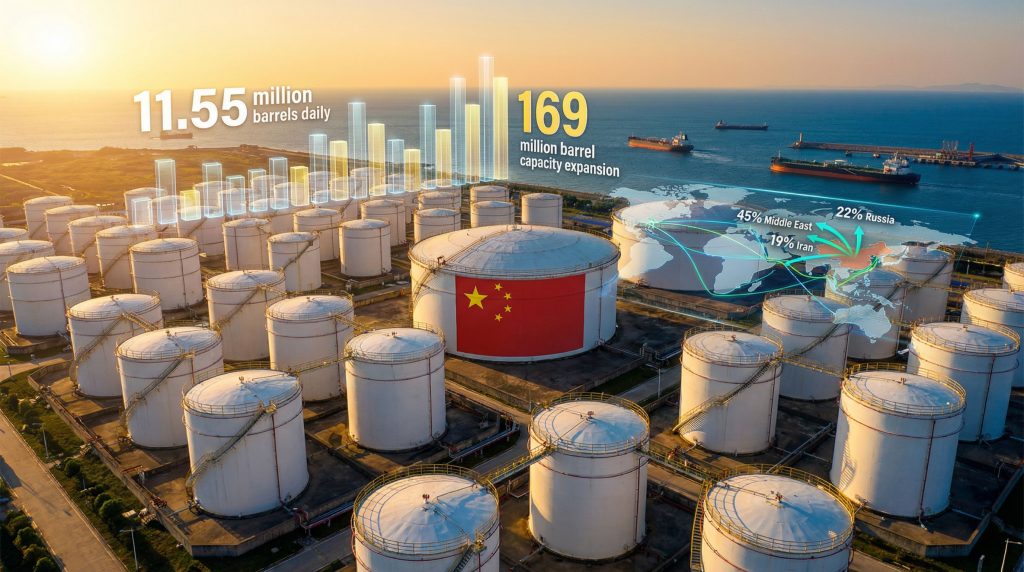
China's petroleum procurement strategy achieved remarkable scale throughout 2025, with import volumes reaching 557.73 million metric tons annually, equivalent to 11.55 million barrels per day (bpd). This represents a 4.4% increase from 2024 levels, demonstrating sustained growth despite global economic headwinds. Furthermore, the December 2025 performance proved particularly striking, with monthly imports reaching 55.97 million metric tons or 13.18 million barrels per day, marking a 17% year-over-year increase.
Infrastructure Investment as Strategic Enabler
The acceleration in import volumes directly correlates with expanded storage capacity deployment across multiple provinces. Storage facility investments enabled average daily stock builds of 430,000 barrels per day throughout 2025, representing a 412% increase from the previous year's 84,000 barrels per day accumulation rate. This dramatic expansion reflects deliberate policy coordination between state authorities and commercial operators.
According to oil price movements analysis, approximately 50% of the stock build growth resulted from new storage capacity additions by both state-owned enterprises and independent companies. This mixed investment model distributes storage infrastructure across geographic regions whilst reducing single-point vulnerabilities in petroleum supply chains.
Provincial Storage Distribution:
- Guangdong Province: Accumulated over 12 million barrels in December, primarily through state-owned facilities linked to Sinopec's Maoming refinery and PetroChina's Jieyang complex
- Shandong Province: Added nearly 15 million barrels during December, coinciding with record-high sanctioned crude imports into the region
- National Inventory Achievement: China's crude oil inventories reached a historic high of 1.206 billion barrels by late December 2025
Economic Arbitrage Through Geopolitical Conditions
The strategic timing of China's procurement acceleration leveraged significant cost advantages created by international sanctions regimes. Ye Lin, Vice President at Rystad Energy, identified energy security as the primary motivation, noting that the average crude cost in China was $10 per barrel lower than in 2024 amid sanctions-related supply disruptions.
This price differential created powerful economic incentives for accelerated purchasing, allowing China to simultaneously build strategic reserves whilst capturing substantial cost savings. The arbitrage opportunity emerged from reduced competition for sanctioned crude supplies, as many developed-market buyers avoided these sources due to compliance concerns.
When big ASX news breaks, our subscribers know first
Refinery Throughput Optimisation and Industrial Demand Patterns
China's crude oil processing capacity reached 15.38 million barrels per day in 2025, representing a 0.7% increase from the previous year. This modest growth in refining throughput compared to the 4.4% increase in crude imports clearly demonstrates that procurement decisions extended well beyond immediate processing requirements.
Import Quota Allocation Mechanisms
The November 2025 allocation of import quotas to independent refiners directly enabled the December purchasing surge. Muyu Xu, an analyst at Kpler, noted that independent refiners gained access to additional spot cargo purchases following these quota allocations, demonstrating coordinated policy implementation across state-owned and private sector participants.
This quota system allows central authorities to manage strategic petroleum accumulation whilst maintaining market-based pricing mechanisms. In addition, independent refiners contribute to national energy security objectives whilst pursuing commercial optimisation strategies within their allocated volumes.
Storage as Demand Decoupling Strategy
The expanded infrastructure enables China to separate purchasing decisions from immediate consumption requirements. This capability proves particularly valuable during periods of favourable pricing or supply disruption concerns. Consequently, December's 35 million barrel inventory increase exemplifies how storage capacity facilitates opportunistic accumulation during optimal market conditions.
Geopolitical Supply Chain Diversification and Risk Management
China's oil imports 2025 supplier portfolio reflects sophisticated risk management across multiple geopolitical environments. The December 2025 data reveals active rebalancing between sanctioned suppliers, with Iranian imports declining below 1.3 million barrels per day from November's 1.5 million barrels per day level, whilst increased Russian supplies filled this volume gap.
Sanctions-Driven Market Opportunities
Emma Li, an analyst at Vortexa, observed that increased Russian supplies displaced some Iranian barrels during the November-December period. This substitution demonstrates China's ability to optimise supplier relationships within monthly timeframes based on relative pricing, logistics efficiency, and geopolitical risk assessments.
Key Supply Diversification Elements:
• Middle Eastern Sources: Traditional partnerships providing supply stability with moderate geopolitical risk
• Russian Federation: Sanctions-discounted crude requiring Arctic and Pacific transportation routes
• Iranian Sources: Secondary sanctions exposure balanced against significant price advantages
• African Producers: Emerging partnerships offering additional geographic diversification
• Americas Region: Market diversification with lower geopolitical risk factors
Transportation Route Optimisation
The geographic distribution of supplier relationships necessitates sophisticated logistics planning. Russian crude substitution for Iranian alternatives requires longer Arctic Ocean and Pacific routing compared to direct Persian Gulf access, yet pricing differentials justify these additional transportation costs.
Storage facility positioning in coastal provinces like Guangdong and Shandong indicates strategic focus on deep-water port access capable of accommodating large crude carriers from diverse international sources. However, this infrastructure supports flexible sourcing strategies regardless of geopolitical developments affecting individual supplier relationships.
Storage Infrastructure Development and Capacity Utilisation
China's storage infrastructure expansion represents one of the most significant petroleum logistics investments in recent history. The addition of 169 million barrels in new storage capacity throughout 2025 directly enabled the dramatic increase in daily stock accumulation rates observed across multiple provinces.
Commercial Storage Versus Strategic Reserves
The mixed ownership structure of storage expansion reflects coordinated strategy between state petroleum reserves and commercial inventory optimisation. Independent refiners contributed substantially to new capacity additions, suggesting that strategic accumulation extends beyond government-mandated reserve targets to include commercial inventory management.
Storage utilisation rates approaching 1.206 billion barrels by year-end indicate that China's oil imports 2025 inventory levels now represent approximately 104 days of supply at current import rates. This inventory cushion provides substantial flexibility for managing supply disruptions or capitalising on future market opportunities.
Regional Infrastructure Distribution
The concentration of storage investments in Guangdong and Shandong provinces demonstrates strategic positioning near major refining complexes and international shipping terminals. These locations offer optimal logistics efficiency for both crude imports and refined product distribution to domestic consumption centres.
Infrastructure Investment Highlights:
-
State-Owned Facilities: Strategic petroleum reserve expansion aligned with national energy security objectives
-
Independent Operator Storage: Commercial inventory optimisation supporting flexible procurement strategies
-
Port Terminal Integration: Deep-water access enabling large-vessel crude imports from global suppliers
-
Pipeline Connectivity: Distribution networks linking storage facilities with refining and consumption centres
Market Psychology and Investment Implications
China's record-breaking import performance reflects broader shifts in commodity market psychology, where strategic resource accumulation serves multiple economic and geopolitical objectives simultaneously. The willingness to build substantial inventories during periods of uncertainty demonstrates confidence in long-term energy demand growth despite short-term economic volatility.
Inventory as Economic Leverage
The accumulation of 1.206 billion barrels in onshore crude inventories represents significant economic leverage in global petroleum markets. This inventory level provides China with enhanced negotiation power in long-term supply agreements whilst creating buffer capacity for managing geopolitical supply disruptions.
Storage-enabled purchasing strategies allow Chinese importers to optimise procurement timing based on market cycles rather than immediate consumption requirements. For instance, this flexibility proves particularly valuable during periods of volatile pricing or supply uncertainty.
Global Market Impact Assessment
China's import acceleration influences worldwide crude oil pricing mechanisms through several channels. The 11.55 million barrel daily import requirement represents substantial demand-side influence on global supply-demand equilibriums, particularly when combined with strategic accumulation beyond refining capacity.
Market Influence Factors:
• Volume Impact: Daily import requirements affecting global crude availability for other buyers
• Timing Effects: Strategic accumulation during specific periods influencing short-term price dynamics
• Supplier Competition: Multiple buyers competing for sanctioned crude supplies at discount pricing
• Storage-Driven Demand: Inventory building creating additional demand beyond consumption requirements
What Are the Future Trajectory Possibilities for China's Oil Strategy?
Several factors will determine the sustainability and evolution of China's strategic petroleum accumulation strategy throughout 2026 and beyond. Economic growth patterns, geopolitical developments, and infrastructure capacity constraints all influence future import trajectory possibilities.
Base Case Development Scenario
Continued import growth appears likely given expanded storage infrastructure and ongoing geopolitical tensions supporting strategic accumulation priorities. Import volumes in the 11.4 to 11.8 million barrel daily range represent sustainable levels assuming current economic conditions and infrastructure capacity utilisation rates between 70-75%.
Optimistic Growth Potential
Stronger-than-expected economic recovery could drive import requirements above 12 million barrels daily, particularly if industrial demand accelerates and full utilisation of new storage facilities creates additional accumulation capacity. Enhanced sanctions-related arbitrage opportunities would further support elevated import levels.
Conservative Outlook Considerations
Economic growth moderation or storage capacity saturation could limit import expansion despite strategic accumulation objectives. Reduced discounted crude availability as geopolitical situations normalise would also affect the economic attractiveness of accelerated purchasing strategies.
The next major ASX story will hit our subscribers first
Investment Strategy Implications for Global Energy Markets
China's strategic petroleum positioning creates significant implications for upstream investment, transportation logistics, and global pricing mechanisms. The sustained import growth trajectory influences capital allocation decisions across multiple segments of the international energy sector.
Upstream Sector Impact
Chinese import demand supports global upstream capital investment by providing reliable market outlets for crude production expansion projects. China oil supply adjustments by suppliers affect production planning and investment priorities to accommodate Chinese volume requirements and specifications preferences.
Long-term supply agreements with Chinese importers offer producers revenue certainty supporting upstream project financing and development timelines. This demand visibility proves particularly valuable for sanctioned producers seeking stable market outlets despite limited international buyer competition.
Transportation and Logistics Development
Expanded Chinese imports necessitate significant tanker fleet capacity to handle increased cargo volumes from diverse global suppliers. Shipping infrastructure investments include larger vessel deployment and route optimisation for efficient crude transportation from multiple source regions.
Port terminal upgrades support larger import volumes whilst pipeline infrastructure development reduces maritime transport dependencies for certain supplier relationships. These logistics improvements enhance supply chain resilience whilst reducing transportation costs over time.
Risk Assessment and Strategic Considerations
Whilst China's petroleum accumulation strategy offers substantial benefits, several risk factors require ongoing monitoring and management. Economic, geopolitical, and operational challenges could affect the sustainability of current import acceleration patterns.
Economic Risk Factors
Carrying costs for strategic petroleum reserves include financing expenses, storage facility operational costs, and opportunity costs of capital deployed in inventory rather than alternative investments. The $10 per barrel cost advantage must remain sufficient to justify these carrying expenses over time.
Currency fluctuations affect the cost structure of crude imports, particularly given the dollar-denominated nature of international petroleum transactions. Exchange rate volatility could influence the economic attractiveness of continued accelerated purchasing strategies.
Geopolitical Risk Management
Dependence on sanctioned suppliers exposes China to potential secondary sanctions risks or supply disruption possibilities. Diversification across multiple supplier relationships helps mitigate these risks whilst maintaining access to discounted crude supplies.
Changes in international sanctions regimes could eliminate current pricing advantages or create new compliance challenges for continued imports from specific suppliers. However, oil price stagnation concerns and flexible sourcing capabilities help manage these evolving geopolitical conditions.
How Do OPEC Dynamics Affect China's Strategy?
The relationship between China's oil imports 2025 and OPEC meeting impact decisions demonstrates sophisticated market navigation across multiple producer coalitions. China's procurement strategy adapts to production decisions from both OPEC+ members and non-OPEC suppliers, optimising costs across diverse supplier relationships.
OPEC production policies influence crude availability from traditional suppliers, whilst sanctions-related supply disruptions create opportunities for strategic accumulation at favourable pricing. China's storage infrastructure enables flexible timing of purchases to capitalise on both OPEC production adjustments and geopolitical price dislocations.
Market Timing Optimisation
Chinese importers demonstrate remarkable ability to time purchases around OPEC announcements and seasonal demand patterns. The December 2025 surge coincided with favourable fourth-quarter pricing conditions, demonstrating coordination between commercial procurement teams and strategic policy objectives.
Storage capacity expansion provides Chinese buyers with enhanced flexibility to adjust purchase timing based on OPEC production decisions, sanctions developments, and seasonal pricing patterns. This capability transforms China from a price-taking consumer to a market-timing strategic purchaser.
Long-Term Energy Security Implications
The strategic petroleum accumulation achieved through China's oil imports 2025 creates long-term energy security benefits extending beyond immediate supply disruption protection. Oil price crash hedging through strategic reserves provides economic stability during volatile market periods.
Strategic inventory levels approaching 104 days of supply provide substantial buffer capacity for managing various supply disruption scenarios. This inventory depth enables China to maintain economic stability during geopolitical crises whilst potentially capitalising on market dislocations affecting other importing nations.
Technology Integration and Efficiency Gains
Advanced inventory management systems enable optimal utilisation of storage infrastructure whilst minimising carrying costs through sophisticated rotation strategies. Digital monitoring systems support efficient crude quality management across diverse supplier specifications and storage facility characteristics.
Integration between storage facilities, refining operations, and transportation networks creates operational efficiencies reducing overall petroleum supply chain costs. These technological investments support sustained strategic accumulation whilst maintaining commercial competitiveness.
China's oil imports 2025 record-breaking performance throughout the year represents a fundamental transformation in global petroleum market dynamics. The combination of strategic reserve expansion, geopolitical arbitrage, and infrastructure investment creates a sophisticated framework for energy security enhancement whilst capturing economic advantages from market dislocations.
The achievement of 557.73 million metric tons in annual crude imports, supported by 169 million barrels of new storage capacity, demonstrates successful coordination between strategic objectives and commercial opportunities. Furthermore, this approach positions China as the dominant influence in global crude oil trade, with purchasing decisions increasingly determining worldwide supply-demand equilibriums and pricing mechanisms.
Disclaimer: This analysis contains forward-looking statements and projections based on current market conditions and available data. Actual future developments may differ significantly from these assessments due to economic, geopolitical, or technological changes. Readers should conduct independent research and analysis before making investment or strategic decisions based on this information. Petroleum market dynamics involve substantial volatility and risk factors that could affect projected outcomes.
Are You Searching for the Next Big Mining Discovery Opportunity?
Discovery Alert's proprietary Discovery IQ model delivers instant notifications on significant ASX mineral discoveries, empowering investors to identify actionable opportunities well ahead of the broader market. Understand why major mineral discoveries can generate substantial returns by exploring our comprehensive database showcasing historic examples of exceptional market performance, then begin your 30-day free trial today to position yourself strategically for the next breakthrough.